


What equipment do I need to play electric guitar?
You’ve listened to this new song and the guitars knocked you on your backside. Wow, that was amazing. You listen a few more times and you feel utterly exhilarated. A voice begins to whisper in your head, then you have an idea. I want to play guitar, I want to play that song, and I want to do it right now. But what the hell do I need to play guitar? You would be surprised. Not a lot.
To play electric guitar the minimum equipment a guitar player needs are:
- Guitar.
- Guitar strings.
- Selection of plectrums (pick)
- Instrument cable.
- Tuner.
- Amp or amp simulator.
Optional equipment needed to round out gear are: Guitar strap, strap lock, metronome, gig bag, fx pedals (pedal board), capo, a great teacher (me!).
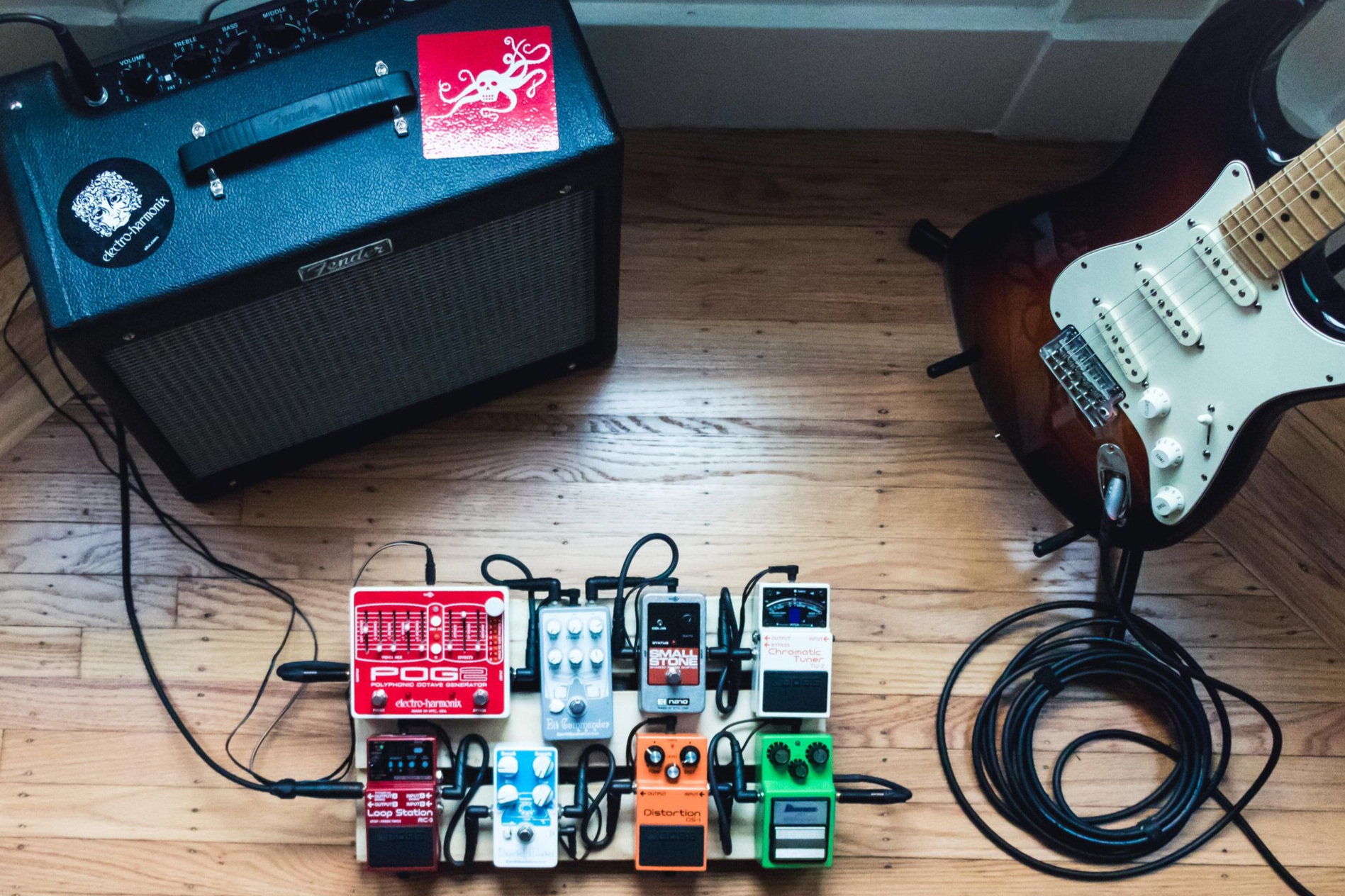
The absolute minimum to get you 90% there.
Guitar.
Probably the most difficult piece of equipment to decide on, choosing your first guitar can be a minefield, but that’s OK because we have a map to navigate these treacherous waters.
DON’T just walk into a guitar shop and pick a guitar that looks cool or sounds nice to you at the moment. If you are an absolute beginner you won’t know what you’re listening for and you won’t make the guitar sound how you want it to anyway.
DO research the bands you love and find out what they all play within the style you want to play in. Write a list of guitars and who plays them, If there is a common theme with the type/ model of guitar then it’s a safe bet that that guitar has what you need. If professionals are playing that guitar then chances are it is a very good guitar. But please try it out at the store first, it may not feel right for you.
You can go with the above method Unless Its way too expensive and nowhere near your budget. If this is the case you have a few options:
- Find a cheaper variant guitar of the model within the brands range or find a different brand with similar guitar specs in a lower price range.
- Save your money and get the guitar you want first go. This is the decision I would make as a guitarist but only if you seriously plan on getting into guitar otherwise it would be a poor investment.Finding a great guitar under £300 can be difficult, not unheard of but unless you know what you looking out for chances are good you will buy a dud. You don’t want to be fighting a bad guitar when starting out, you want things to be as easy as you can.I would advise a guitar in the realm of £700 to £1000 that you plan on digging into for the next 10 years. You will have a great guitar which will lower the entry level difficulty, decrease the chance of you giving up and you won’t need to bother with the faff of selling your bad guitar to get a good one later on.
Amp or amp simulation.
You need to plug your electric guitar into something to produce the sound of an electric guitar. Your options are an amp or amp simulator and personally I would go with amp SIM for beginners. But why?
- You get a professionally modelled, expensive amp and cabinet combination with multiple microphone setups plus EQ’s, compressor, overdrive, delay and reverb pedals all in one bundle plus the simulators today are so damn close to a real thing a beginner will never even perceive the difference.
- Having thousands of pounds worth of equipment for less than £150 is an absolute bargain for a beginner (for a single amp setup).
- You get to try out the expensive stuff and learn what everything does before you put money down on the real thing.
- Some bundles a LOT of different heads and cabs to choose from at a very reasonable price.
MY AMP SIMULATION RECOMMENDATION:
Neural DSP: Archetype Nolly. Most professionals consider this company to have the most realistic amp sims on the planet. This is the most versatile option from Neural DSP with 4 different guitar heads for clean, crunch, rhythm and lead tones. 4 fx pedals, EQ, 4 cabinets and 4 fully movable microphones. But don’t worry, there are some amazing presets for you to get stuck into if this seems a little too complex at first.
Still, unsure? Every Neural DSP plugin has a free trial so try them all.
BONUS TIP: Wait for a sale, they have them at least 3 times a year.

What about a real amp?
Same with the guitar, find out what the bands you love play in the genre you want to play guitar in. Or go with an amp sim, see what you like and then buy the real thing.
Having a real amp has not yet been beaten for real recording of an electric guitar but its damn close. When it comes to recording there is more messing about with physical mics cables, stands etc.
Plectrum.
Plectrums not only change the feel of what you play but also the tone, Generally the thinner the pick the brighter and clearer the tone. It’s amazing the difference in sound and it took me 10 years to try something new and realize I was using the wrong plectrum for me for all that time. Now I am faster, brighter and clearer.
I suggest you buy a pack of plectrums from say Dunlop with a range of different thicknesses to see what’s best for you and your style. At the moment I’m loving the 0.76mm plectrums.
Book your Guitar Lessons here!!
Guitar strings.
You may as well play drums on your guitar if it doesn’t have strings. But which ones? What gauge? (gauge is how thick the strings are.)
You can buy practically any reputable brand such as Ernie ball, D’Addario, Elixir. All of which come in different thicknesses. This can be very confusing especially with the different names each company has. So I think it’s best to stick with a recommendation.
I recommend: D’addario NYXL – 9-42 Gauge. This is a classic brand with a classic size. I’m keeping the strings thin for you to make it easier for a beginner to play, less pain in your fingers while learning plus the tone is much brighter and clearer than thicker strings.
Cables and tuners
Cables: you want to play you’ve got to plug your guitar in. just get a good quality well reviewed guitar cable and you’re sorted. We use MOJO Cables here at All About Guitar and are available here: www.allaboutguitar.co.uk/shop
Tuners: Want to not sound like an elk in the final stages of labour, then a tuner is so so so important. Many amp simulators have them built in but I would recommend getting a stand-alone tuner for if you are away from your computer, in a practice room or gigging. Headstock tuners are very popular at the moment but any well recommended tuner will do.
A QUICK BUYERS GUIDE LIST.
- Guitar you know that fits your style.
- Neural DSP: Archetype Nolly amp sim.
- D’Addario NYXL – 9-42 Gauge.
Make sure you get your guitar professional setup to the string gauge you have decided most suits you. - Dunlop Celluloid Guitar Picks range, Thin, medium, heavy, extra heavy. Find out now what’s good for you.
- D’Addario Planet Waves instrument cable.
- KORG GA-2 Pocket Digital Tuner
That’s it. Hope this has helped you begin your guitar journey. Have fun and make some great music.
Book your Guitar Lessons here!!


